Wednesday, May 25, 2022

Taste, and See


On a wintry Saturday, I baked cinnamon maple scones at our cabin, using a new-to-me recipe. They were so yummy, I was eager to share them at our church potluck breakfast the following morning. But I coughed through the night, and it became clear neither I nor my husband would be attending church that Sunday. I was disappointed to miss blessing my church friends with my flavorful scones.

Before driving down the mountain, we parked our car in town to take a short walk around the lake. Two ladies we recognized sat at a picnic table across the road. “Do you want some scones?” I yelled through my mask with my hoarse, raspy voice. 

“Absolutely, yes, we do!” Kathy and Donna replied.

My husband retrieved the container holding the scones from the car and carried the treats across the road to our excited friends. “Take two!” I called over.

“Can we have three each?” they hollered back.

We continued our walk around the lake, and upon arriving back to our car, our friends let us know how much they enjoyed the delicious pastries. I don't know whose joy was more full, Kathy and Donna's in savoring the scones, or mine, in getting to share them. 

There’s a taste-and-see simplicity I experience when I share what I’ve baked. I don’t have weighty expectations on myself to “be somebody” in the kitchen, to become known as “Diane the baker.”  It is as simple as, “Here’s something I’ve made that is good. I hope it blesses you.” 

I was due to deliver a set of six benedictions this week for the Black Barn, an online community I belong to. I’d written and rewritten many and could not decide which ones to submit. The angst I experienced squeezed the joy out of writing and anticipating blessing others with my offerings. I tell myself, oh, but this is not a scoop of dough; it’s a scoop of my heart. Of course it’s going to be painful.

Perhaps my “of course” is off course.

I learned recently the word "companion" is derived from Latin and, at its core, it denotes someone who is present to you "with bread." As we are present to each other on this journey, we offer life-giving nurture and enjoyment, friend to friend. We bring who we are and what God has given us to offer. How good it is to have someone fully present to you; how much better when together you “break bread,” when together you unwrap and savor the good gifts God has given you. Together, we celebrate the Giver of the gifts. 

Again and again my thoughts return to the simplicity of baking something then sharing it, with a spirit of, “Taste and see the goodness!” 

I wonder what it would be like to experience such freedom as I weave words together and then share them. I wonder what kind of companionship I could bring to others, free from self-judgment about what I bring to the table. And I wonder whether God is inviting me to taste this kind of freedom, and to see that it is good.

diane mann, 2022


Thursday, July 1, 2021

A Beauty, All Its Own


“I just don't see it, Daddy,” I said. “It looks ugly to me.” I stood watching my dad gaze in adoration over the desert landscape, his eyes resting in reverence upon what stretched before him.
“The desert has a beauty all its own, Diana.” 
I was ten years old and enjoyed camping in the desert, scrambling over rock formations but saw nothing of beauty in the dusty landscape, cacti, and brittle shrubs. The view, in my eyes, was something to be tolerated, rather than enjoyed.

I never intended to become a student of the desert, but a decade ago my job as a court reporter led me to familiarize myself with all things desert as I took on an assignment to report public meetings held several times a year by the Desert Advisory Council, part of the Bureau of Land Management. The Council's duty is to gather information from the public to inform the Bureau of how their land-management decisions and plans affect people holding various interests in the desert.

Though many interests are represented among the positions on the Council – wildlife, renewable energy, recreation, off-highway vehicles, farming, mining, Native cultural interests, wildlife habitat and conservation – each person who is part of these meetings has a unique affection for the California desert. One of the hopes expressed by the Council is that people will not just see this vast landscape as a place to just drive through on their way to somewhere else, but to slow down and appreciate what the desert offers, to see up close what it is made of, its history, geology, resources, and ecologic systems.

The day before each meeting, I attend a field trip with the Council and the public, where we visit different sites that will be discussed at the next day's meeting. This affords me an opportunity to get to know the people who will be speaking the next day and familiarize myself with names of sites, projects, plants, and species that were previously foreign to me.

Just a gas tank to the north of where I live sits the loved-by-me Sierra Nevada Mountain Range, the area explored by John Muir, who wrote words of praise about the mountain range and its good effects on us.

But between my home and those glorious mountains sits a vast desert I previously saw as a wasteland.

As I look out the car window on my drive north to the Sierras, where towering pines and emerald glacial lakes await me, I now appreciate the harsh beauty of the vast desert, raw and exposed and not afraid to show me its not-so-pretty parts, somehow beckoning me to live more authentically. I see nuanced colors I’d previously ignored, and I wonder how I ever viewed the desert as devoid of beauty.

I see shrubs scattered over the landscape, with complex root systems that join with each other deep underground, forming their own internet! If one shrub becomes diseased, it sends out messages to the others so they can produce defenses against the threat they've been warned about.

I see solar plants that produce clean energy but are drawing upon groundwater deep below the earth's surface, water that's been flowing for tens of thousands of years and needs to be considered before too much development is planned on the surface.

I see Native American cultural resources, like the line in the sand I visited toward San Diego. An ancient tribe used to make a pilgrimage once a year to worship their god they saw as Creator. A while into their journey, a line was etched into the sand, now sun-baked and preserved for us to learn from. The story is passed down that, before the pilgrims would go any further on their journey, this was the space where unforgiveness was to be laid down. One could not make the journey with the extra weight on them so must leave behind the desire to retaliate against another before taking one more step.

I see rotting, vacant homes, weather beaten and barely standing. I now know that, if you find a piece of trash or abandoned property in the desert that has been there over 50 years, it is considered a historical artifact, and by law you are not allowed to move it! Rusted-out automobiles and tin cans tell a story.

I see dirt roads that lead to rockhounding sites, where those who collect rocks impress me with their passion and dedication to their hobby. While many of us look up in amazement – at the grandeur of mountains or the sky's expanse – rockhounds look down and are equally amazed at what they find. I've not seen a rockhound talk about their love of rocks without trying to hold back tears as they speak.

As I pay close attention to the people I listen to in this unique assignment, I'm reminded of my Dad with that look in his eye as he enjoyed the desert's beauty. Oh, if he were still here on earth, I'd love to tell him what I see now. When my father was 64, he suffered a fall and endured 19 months of being completely paralyzed and ventilator dependent, experiencing his own harsh desert journey through quadriplegia. After he died, I wrote a song about him. Here is the chorus: 

“The desert has a beauty all its own

It’s not the mountains we adore

No tall trees, no sandy shores

Just look closer, take some time

Feel the wind, hear the rhyme

Dry earth below, blue sky above

Clay-colored rocks to climb upon

Stop to see what I see, then you'll know what I know 

The desert has a beauty all its own.”

A beauty all its own. That is a refrain that is sometimes difficult to remember or believe. Lately, I've been dividing life into pre-pandemic time, pandemic time, and gratefully, post-pandemic time. The pandemic was something we endured (and for some are still enduring), a desert highway in many ways, a wasteland of space through which we traveled with visions of just getting through to the other side.

But if we stop to reflect, we will find it was more than a space of barren, dry land. There were people we connected with who sent encouragement from afar; ancient, life-giving springs below ground that made us dig deep to reach them; lines drawn, where we were challenged to let go of deep-seated unforgiveness, adopting understanding instead; gems we picked up along the way; and artifacts, stories of faith we left behind for Christ-followers in the future, who will look for signs of how we endured, believers we will one day surround as a cloud of witnesses.

May the Lord give us eyes to see what He sees, so we will know what He knows. 

I wonder, as the mountains open up before us and the long, dusty road of the pandemic is appearing in the rear-view mirror, what can you reflect on that magnifies your appreciation for beauty found in dry places? How does this noticing lead you to worship?

Last Image: "Desert in Rearview Mirror" by Vivian Chepourkoff Hayes. 

Saturday, March 13, 2021

Uncontained


It's a small thing, really. But it's catching my eye at unexpected times, in unexpected places, and I can't seem to shake it.

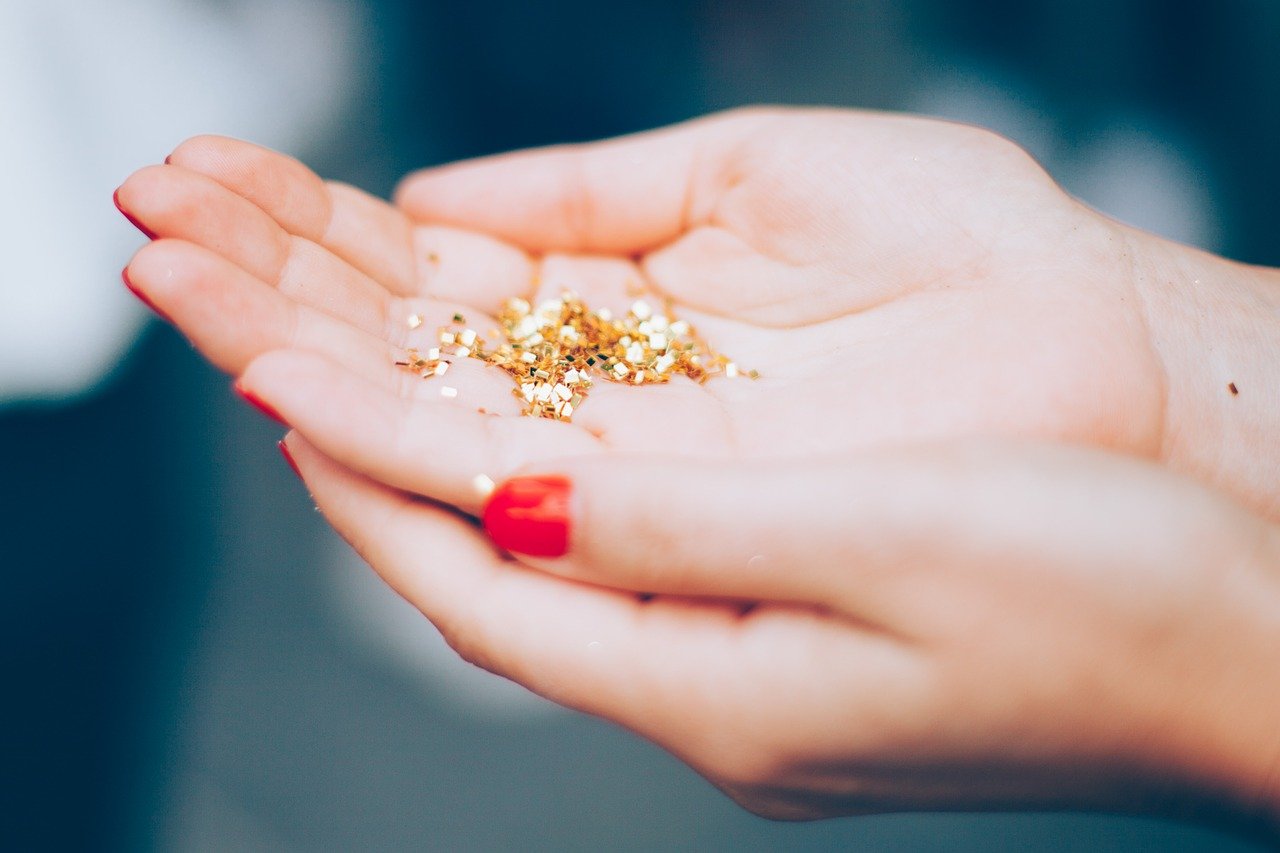
Over a year ago, I set up a card table in my family room and covered it with craft supplies––paper, stickers, glue, jeweled embellishments, decorative tape, ribbons, and glitter.  Yes, glitter, fine red glitter, contained and congregated in a small jar. When family gathered at my house, some accepted the invitation to sit at the craft table to play and create valentine cards.

No one played harder than Calvin, my three-year-old grandson. To him, there was no such thing as sprinkling glitter, only pouring glitter. Red specks generously billowed about him, with just a fraction landing on their intended target. Calvin happily created a brightly colored, sparkly, shiny, sticky, beautiful mess.   

During February, it was a mess I enjoyed. But at month's end, I bagged up the craft supplies and put away the card table, taking broom, dust cloth, and vacuum to the area, cleaning it up as best I could. 

Like sand that comes home from the beach with you, later found in your children's ears and hair, in the creases of your car, the bottom of your purse and your washing machine, my red glitter inhabited unlikely spaces.  It rested between and within books on the shelves, couch cushions, edges and ledges of my home. I can't trace their journey, but some of those invasive red flakes traveled to my mountain cabin fifty miles away. 

Though they sparkle with the same brightness as they did the day I bought them, now when the shiny specks catch my eye, they no longer hold the beautiful memory of fun times at our craft table. Instead they carry condemnation. They tell me I am sloppy, that I always leave things undone, and that there's no hope for me. They were intended to embellish cards celebrating love, yet now, weightless as they are, they transport heavy, damning messages:

I can't contain my glitter. I can't contain me. I haven't finished cleaning up from a project I started 13 months ago. How dare I move on to the next thing, not having tidied up from the last thing? The accusations fly and land me in a decades-old memory.

I returned home from Los Angeles, where I had completed a two-day examination to become a certified court reporter. I was tired but elated, floating on a wave of emotions, and still dressed in an outfit that made 20-year-old me look and feel professional, competent, legitimate. 

"How did it go?" my dad asked from his chair in the corner of the living room, while I was just a few steps into the entryway. Through a beaming smile I told him how well I believed I had done, how relieved I was that the test I worked two years to prepare for was behind me. My words spilled out.

Having overheard me describe my time, my mom marched from the kitchen and planted herself a foot from me with her fisted hands on her hips. She was a beautiful woman, but the anger scribbled across her face in this moment blotted out any signs of that beauty. "Yeah, but is your room clean?" The words, uncontained, flew from the jar. Like the glitter I still can't clean up, they were red, they landed in unintended spaces, and just when I think I’ve remembered the last of them, they catch my attention yet again. 

Anymore, it doesn't really matter what comes after the "Yeah, but." I can quickly render as illegitimate the ideas that rise up in me. 

“Oh, I’ll send Carol a card,” I think to myself. “Yeah, but what about Shirley?” 

“I’ll weave those thoughts that have been dancing through my mind into a poem,” then, "Yeah, but what about that piece you never finished, or those writings you thought about but never even started?” 

I long to speak hope into others during this weary, drawn-out time of the Covid pandemic. “Yeah, but I myself am often weary and discouraged,” and, “Yeah, but there are so many voices out there hoping to bring light into dark places." The "yeah-buts" circulate about and get too much time on my mind's stage. 

From the ampitheatre of Earth, I look up at the night sky and see the stars, still multiplying, God lavishing the universe with sparkles. They swirl and float, those captivating curlicues, brightening my dim eyes, satisfying my thirst for wonder and awe. If there is more room for stars in the sky, is there space for a sparkle, a fleck of light, another word carrying a glimmer of hope? Can I yield to God's pouring into me then through me words that bring courage, trusting they will land on the hearts of those who need them? 

A scene I recall from a 9/11 documentary re-enacts two men buried deep under rubble from an exploded building next to the World Trade Center towers. The men lay injured and trapped a good distance from each other. A small stream of light from above squeezing through the rubble could be seen by one of the men, while the light's ray was blocked from his comrade’s view. They knew as long as there was light, there was an opening through which someone could reach them, a sliver of hope. The man who could see the light kept reassuring his friend of its existence, until the rescuers reached them.

I look down in church on Sunday, and my eye catches a miniscule red sparkle in the center of my phone. I sigh. Again I look down, this time at a Bible placed on the end of the pew. White glitter, catching the light, is strewn across its cover. I look up to see the pastor's wife has decorated the sanctuary for winter, with glimmering snowflakes resting on green pine boughs surrounding the ceiling’s edge. I smile to realize she also could not contain her glitter. It feels like hope, for me, to know that others move forward beautifying the world with their creative ideas, even though they may leave a bit of a mess behind. 

If I can see the sparkle when you can't and you can see it when I can't, let's tell each other about it, shall we? Let's remind each other of the light, even if just a flicker.

It's no small thing, really.


Saturday, October 10, 2020

Repositioned

undefined

It's been fun this week, exchanging hilarious stories on Facebook after I've shared the latest ditsy things I've done. Sunday, I  grabbed a bottle of Downey Wrinkle Release from the hall cupboard. I sprayed my oatmeal-colored sweater several times, smoothing over the wrinkles with my hands. It wasn't working as well as usual, I noticed, so doused the sweater again and again. The smell of bleach reached my nose, and I looked at the bottle's label to find I had really been using a foaming bathroom cleanser with bleach! Stories like this must be shared, so I instantly posted a picture of my newly tie-dyed sweater to Facebook, where I enjoyed being laughed with and hearing of other people's foibles. 

This morning, Tuesday, I made myself coffee from my Keurig, like I do most mornings. Unlike most mornings, I placed the mug under the spout, pressed the button, and immediately the mug started overflowing, spilling coffee over the countertop.  Upon closer inspection, I saw I had placed the mug under the spout upside down, as in bottom side up. Another Facebook post, more LOLs, more stories shared.

I've done some funny accidental things in my life, from wearing two different shoes in public, to being affectionate with a man I mistook for my husband in a crowded elevator. He was much more gracious than the ballcap-and-windbreaker-wearing bearded man in the self checkout at Wal-Mart, who after my accidental hug and sincere apology, refused to laugh with me and ran from the store, not looking back.

While on the outside, I am laughing, after this morning's coffee mishap, I keep having this not-funny conversation in my head: If you want to feel, "ept," just hang around me. I'm so inept.

That is harsh, is it not? 

Why am I exceptionally scattered this week? The calendar reminds me that five years ago I saw my mom alive and well for the last time. She walked into my house with a friend, without knocking—again. I stayed in the kitchen, fuming over her violating my well-defined boundaries, while my daughters doted over her near the front door. I hugged Linda, the friend she brought, and withheld a hug from my mom. Before she left, we discussed when we would have time to bake pumpkin bread together, and I pointed out to her a Mother's Day card on the counter I hadn't given to her. "I finally found it," I said, having misplaced it after purchasing it in May. "It's the prettiest one I've ever bought you, but I haven't signed it yet, so I will give it to you after I write something on it."  

Two days later she fell while walking to the church bus during a senior field trip. Her walker got stuck in a crack on hilly pavement, and she flipped, landing on her head. The impact caused a catastrophic brain bleed that within a few minutes led to her being unconscious. She was helicoptered to a hospital and attached to life support, which kept her breathing the next couple days, until family could all arrive to say goodbye. I whispered in her ear before the medical team unplugged her, "I forgive you. I hope you forgive me, too."  I did keep my promise and gave her the pretty Mother's Day card, signed, setting it next to her in her coffin.

This is the week each year I am spacier than normal, less aware of my surroundings, slogging through life in a fog. Grief disorients me, and these anniversaries of loss always sneak up on me unaware. 

"Give yourself grace," people say to me, and I have said it to others. But I'm not the source of grace and can't seem to brew up enough for myself, or for anyone else. Yet I know—how I know—a softer gaze is needed, on myself, and on my mom, who sometimes scooched her way through my front door and over the well-meaning fences I'd built. A nicer rule-breaker you've never met!

The ache feels like a hollow longing in my chest, and my eyes leak off and on throughout the day. But I'm not turning away from letting myself feel the regret of the withheld hug, not this year.

I sit and move through the day with Jesus, this grieving heart facing toward Him, exposed, empty, not upside down, like my coffee mug. Here, His grace pours into me. My cup is being filled, not resisting what Christ is offering. I sense His softer gaze upon me. Repositioned under the fount of grace, I am full to the brim, even overflowing. 

I'm letting my regret usher me into a place where I am re-greeted by grace. There is no room for harshness, here.

Is there an area in your life you need Christ's gaze upon you? Something you've refused to acknowledge before God? Perhaps you, too, see the need to reposition yourself under grace's fount.